Page 2 of 5

IYS Issue 8.1

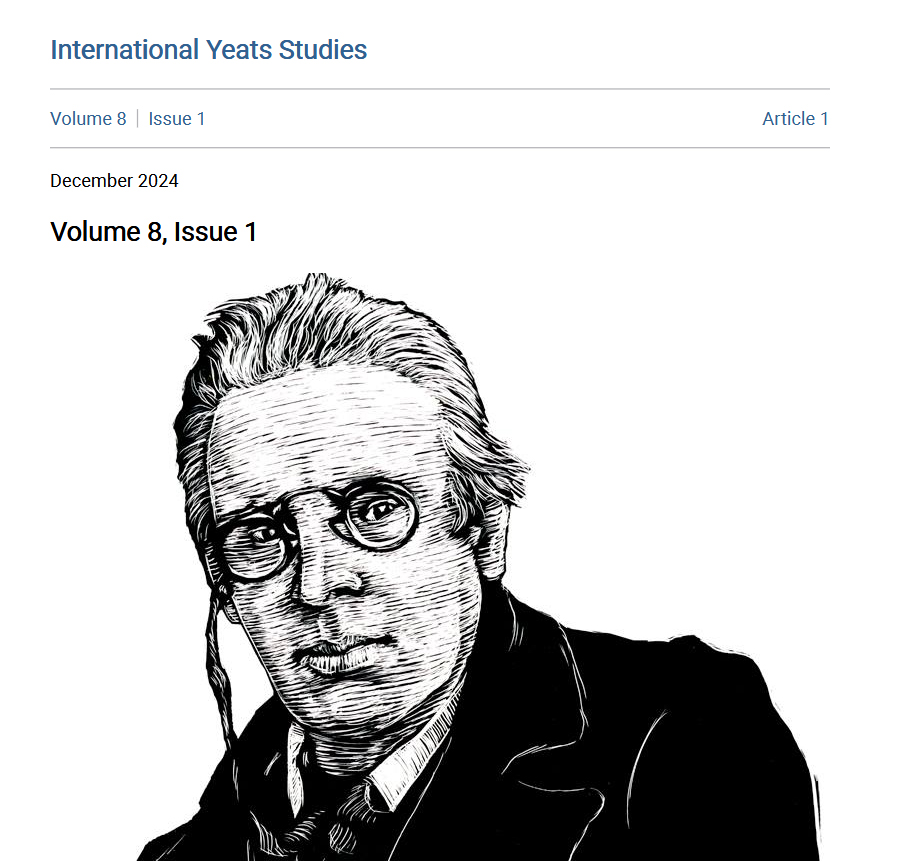
The International Yeats Society is pleased to announce that issue 8.1 of the International Yeats Studies journal is now available. You can access it by using the following link:

open.clemson.edu/iys/

The International Yeats Society is committed to being an open access journal, which means that all of the costs for producing each issue come from our membership. If you are not currently a member of the International Yeats Society, consider supporting our mission of fostering academic collaboration across borders by joining today.

The WB Yeats Society of NY’s annual Yeats Poetry Prize is now open for submissions!

The WB Yeats Society of NY’s annual Yeats Poetry Prize is open for submissions through February 1 of the new year. Poems in English on any topic (up to 60 lines each) may be entered by using the following link:

https://Yeats.Submittable.com/submit

The contest is open to anyone, any age, anywhere in the world.

Entry fees: $15 for first poem, $12 for each additional.

First prize $1,000, second $500, and honorable mentions. Winners are recognized at a public event in New York City in April, National Poetry Month. 

The WB Yeats Society of NY offers the yearly competition to honor its namesake and to recognize the valuable contributions poets and poetry make to human consciousness and enlightenment.  Poet January O’Neil will judge the competition, now in its 29th year. Ms. O’Neil also chose the 2024 poems. 

Mariana & Ouro Preto Conference | Second Call for Papers

In section XII of “The Bounty of Sweden”, published transatlantically in both the London Mercury and The Dial in September 1924, Yeats (in)famously conjures two forms to stand at his side onstage at the Swedish Academy: “When your King gave me medal and diploma, two forms should have stood, one at either side of me, an old woman sinking into the infirmity of age and a young man’s ghost.” (Au 535). By invoking JM Synge and Augusta Gregory, Yeats highlights the importance of collaboration in organised movements, societies, and schools in order to effect cultural and social change. Etymologically, coniuro in Latin and its later descendants maintain the prefix con-, indicating that whoever conjures, swears with others, in a conspiracy of at least two. From as early as his swearing into the Irish Republican Brotherhood in the 1880s, throughout his life Yeats was certainly a conjurer in this more archaic sense, as someone who bound himself to others even as he posed as the outcast poet. Creating and dissolving organisations, log-rolling with friends’ publications, shifting allegiances, staging coups and joining splinter groups, in his many arenas of action Yeats attempted to influence the world around him by collective effort.

As a theme for the hybrid 2024 International Yeats Society Conference, Conjuring Yeats comes to the Minas Gerais, the homeplace of the “Conjuração Mineira”, an early separatist movement that sought to create an independent republic in the province of Minas Gerais. Its repression by the Portuguese Crown and the plight of the “conjurates” was incommensurate, and although other rebels had their sentences commuted, the public hanging of its main instigator, known as Tiradentes (or Toothpuller, as Elizabeth Bishop, herself a longtime resident of Ouro Preto, called him), on the 21st of April 1792 took on the Christological imagery later associated to Ireland’s own Easter Rising of 1916.

This conference will address a variety of topics, including but not limited to the following:

  • Yeats, organisations, and secret societies, including political parties;
  • Yeats’s conspirators & collaborators, members of the Irish Revival or modernist cliques;
  • Yeats, rebellion and political strife;
  • Yeats, magic, and belief;
  • Conjuring in non-anglophone contexts: translation and edition as transmutation;
  • The theatrical stage as a space of conjuration
  • Other writers haunted by Yeats or the Minas Gerais “conjurates”. The conference will be hybrid and the in-person events will take place primarily on the Humanities premises of the Universidade Federal de Ouro Preto, in the city of Mariana. Online participation includes:
  • Individual paper participation in fully online or hybrid panels;
  • Participation in full panel proposed as a group, either fully online or hybrid;
  • Remote attendance to online and hybrid panels as well as keynotes. There will also be two different time slots available for remote panels: one in the morning and one in the afternoon, to cater for different time zones (we are in BRT zone, at GMT-3).

Keynotes by Neil Mann (researcher, Finland) and Bruce Stewart (UFRN, Brazil), roundtable with Ragini Mohite (FLAME University, India) and Barry Sheils (Durham University, UK), a new voices lecture by Charika Swanepoel (Turku University, Finland), and pocket performance and interview with the creators of the new adaptation of At the Hawk’s Well in Brazil, Emilie Sugai and Fabio Mazzoni (in Portuguese with consecutive translation).

Please submit proposals for individual papers, group panels or banners to the organising committee via this form by November 10th:

https://docs.google.com/forms/d/e/1FAIpQLSd6bpR3JWNbWItYrMDkbfR5WqA-RFTYGD636WFFxAzVUGMJxg/viewform

If you encounter any problems, please email yeatsbrazil@ufop.edu.br. More information is available on the conference website, https://yeatsbrazil.ufop.br/, and on our Instagram @yeatsbrazil_.

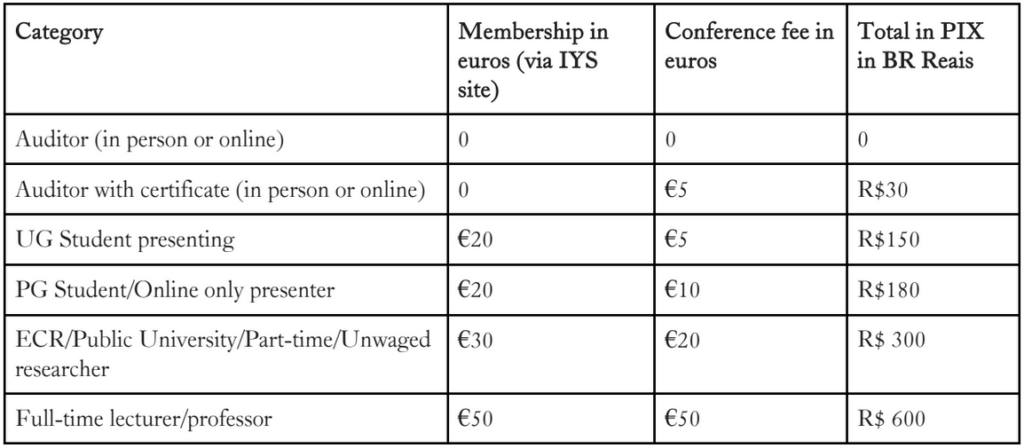
We are keen to support students and academics who are not employed full-time or work in public universities. Conference costs are kept to a minimum and will be as follows, payable by credit card (via IYS), PIX (for Brazilians) or transfer (please contact Rita at m.rita.viana@ufop.edu.br):


A pre-conference excursion to the Inhotim Museum in Brumadinho can be arranged for all interested attendees on the Sunday before the event, December 8. More information is available on the conference website. If you intend to attend the pre-conference excursion, please plan to arrive in Belo Horizonte by December 7 and stay overnight because we leave for Inhotim early on Sunday.

The IYS membership supports students by offering travel bursaries. The bursary is paid up to 800 euros as reimbursement on expenses incurred. If you would like to be considered for the IYS travel bursary please include your abstract, a maximum 200-word statement outlining your case for support to the presidency (Charles.Armstrong@uia.no). This should include detail about your current research project and the relevance of the conference to your ongoing work. All applications will be considered by the conference organising committee/IYS executive Board. Please note that all presenters must be paid-up members of the International Yeats Society. To sign up, please use the following link:

https://internationalyeatssociety.org/members/

The deadline for proposals is November 10th. Registration will open November 1st.


Conjuring Yeats: International Yeats Society Conference 2024

The official website for the 2024 International Yeats Society Conference is now live! This virtual hub will serve as your primary source of information for the upcoming symposium, which is scheduled to take place from December 9-11, 2024, at the Universidade Federal de Ouro Preto (UFOP) in Brazil. 

Visit the website here: yeatsbrazil.ufop.br

For scholars interested in submitting proposals relating to the theme “Conjuring Yeats”,  you are invited to submit your abstract by September 15, 2024.

See the Call for Papers for more information: https://internationalyeatssociety.org/wp-content/uploads/2024/09/Call-for-Papers-August.pdf

Submit your proposal here:  https://docs.google.com/forms/d/e/1FAIpQLSd6bpR3JWNbWItYrMDkbfR5WqA-RFTYGD636WFFxAzVUGMJxg/viewform

Thank you for supporting The International Yeats Society! We hope to see you at this special event. 

Mariana & Ouro Preto Conference | Call for Papers


Conjuring Yeats

In section XII of “The Bounty of Sweden”, published transatlantically in both the London Mercury and The Dial in September 1924, Yeats (in)famously conjures two forms to stand at his side onstage at the Swedish Academy: “When your King gave me medal and diploma, two forms should have stood, one at either side of me, an old woman sinking into the infirmity of age and a young man’s ghost.” (Au 535). By invoking JM Synge and Augusta Gregory, Yeats highlights the importance of collaboration in organised movements, societies, and schools in order to effect cultural and social change. Etymologically, coniuro in Latin and its later descendants maintain the prefix con-, indicating that whoever conjures, swears with others, in a conspiracy of at least two. From as early as his swearing into the Irish Republican Brotherhood in the 1880s, throughout his life Yeats was certainly a conjurer in this more archaic sense, as someone who bound himself to others even as he posed as the outcast poet. Creating and dissolving organisations, log-rolling with friends’ publications, shifting allegiances, staging coups and joining splinter groups, in his many arenas of action Yeats attempted to influence the world around him by collective effort – including the occasions when due credit to others was withheld.

The other, more modern meaning of conjuration is already implied in the act of summoning the forms of Synge and Lady Gregory to the Swedish stage: it involves magic. Having joined The Order of the Golden Dawn on 7 March 1890, Yeats became a full member of the Second Order as early as January 1893, and as such “he could now learn the use of magical instruments, talismans, invocation, conjuration, and scrying on the astral plane” (CL1, 487). Even if, later in life, Yeats reports that the “professional conjurer” who comes to Mabel Beardsley’s sickbed performs little more than parlour tricks to keep the dying lady entertained, Chris Morash has recently argued that because Yeats understood the theatre in magical terms, the conjuring of images onstage would be a way of influencing a much wider population than ritual magic in the context of societies like the Golden Dawn.

As a theme for the 2024 International Yeats Society Conference, Conjuring Yeats comes to Ouro Preto, the homeplace of the “Conjuração Mineira”, an early separatist movement that sought to create an independent republic in the province of Minas Gerais. Its repression by the Portuguese Crown and the plight of the “conjurates” was incommensurate, and although other rebels had their sentences commuted, the public hanging of its main instigator, Lieutenant Colonel Freire de Andrade, known as Tiradentes, on the 21st of April 1792 took on the Christological imagery later associated to Ireland’s own Easter Rising of 1916.

This conference will enable participants to address a variety of topics,
including but not limited to the following:

•Yeats and secret societies;

•Controversies and organisations in which Yeats took part (including the lobbying for the Hugh Lane pictures);

•Yeats, his conspirators & collaborators;

•Yeats, rebellion and political strife;

•Yeats and magic;

•Conjuring Yeats in non-anglophone contexts: translation as transmutation;

•The theatrical stage as a space of conjuration.

The conference will take place on the premises of the Universidade Federal de Ouro Preto, mainly in the city of Mariana, where the Instituto de Ciências Humanas e Sociais is located, but also in the city of Ouro Preto itself. There will also be outings and events in other locations in both cities.

Please forward paper proposals (200-300 word abstracts, for 20-minute papers) or panels to the organising committee via Maria Rita Drumond Viana (m.rita.viana@ufop.edu.br) and Charles Armstrong (Charles.Armstrong@uia.no) by September 15th.

We are keen to support Doctoral students and unwaged academics. We do this by maintaining a reduced IYS membership fee and offering one travel bursary. The bursary is paid up to 800 euros as reimbursement on expenses incurred. If you would like to be considered for the IYS travel bursary please include, along with the abstract for your conference paper, a maximum 200-word statement outlining your case for support. This should include detail about your current research project and the relevance of the conference themes to your ongoing work. All applications will be considered by the conference organising committee/IYS executive Board.

Registration will open September 15th. The conference will take place December 9-11, 2024.

Please note that all participants must be paid-up members of the International Yeats Society. To sign up as a member, please use this link: https://internationalyeatssociety.org/members/

New Release: The Edinburgh Companion to W.B. Yeats and the Arts

Newly available to purchase is The Edinburgh Companion to W. B. Yeats and the Arts, edited by Charles I. Armstrong, Adrian Paterson and Tom Walker.

W. B. Yeats was not only a poet but also a restless collaborator, fostering countless artistic enterprises, from the Abbey Theatre to the Cuala Press, and pursued various inter-artistic media and forums for his work. From childhood co-creations with his siblings to the arresting combination of sound and movement in his final play, The Death of Cuchulain, his work also repeatedly addresses and incorporates music, dance, and the visual, material and theatrical arts with remarkable intensity. For him, literature was a vital thing that engaged, in one form or another, all the senses. This volume’s newly commissioned chapters analyse afresh such engagements. Bringing together scholars of literature, aesthetics, cultural history and specialists in drama, music, dance and the visual arts, they provide a broad range of historical, conceptual, and disciplinary approaches and perspectives.

Use the discount code NEW30 to save 30% off through the link below.

https://www.edinburghuniversitypress.com/book-the-edinburgh-companion-to-w-b-yeats-and-the-arts.html

The Edinburgh Companion to W. B. Yeats and the Arts

The Edinburgh Companion to W. B. Yeats and the Arts, edited by Charles I. Armstrong, Adrian Paterson and Tom Walker – Launch discount code is NEW30 for 30% off.

W. B. Yeats was not only a poet but also a restless collaborator, fostering countless artistic enterprises, from the Abbey Theatre to the Cuala Press, and pursued various inter-artistic media and forums for his work. From childhood co-creations with his siblings to the arresting combination of sound and movement in his final play, The Death of Cuchulain, his work also repeatedly addresses and incorporates music, dance, and the visual, material and theatrical arts with remarkable intensity. For him, literature was a vital thing that engaged, in one form or another, all the senses. This volume’s newly commissioned chapters analyse afresh such engagements. Bringing together scholars of literature, aesthetics, cultural history and specialists in drama, music, dance and the visual arts, they provide a broad range of historical, conceptual, and disciplinary approaches and perspectives.

The Passing of Helen Vendler

The International Yeats Society is deeply saddened to learn of the death of Helen Vendler—the outstanding scholar of Yeats and other modern poets,  A. Kingsley Porter University Professor at Harvard and regular contributor to the Yeats International Summer School. Helen has been a key inspiration for many Yeatsians and her books on Yeats or which include Yeats have informed generations of students. Her obituary is available here: https://www.shelf-awareness.com/issue.html?issue=4713#m63609

« Older posts Newer posts »