Page 3 of 5

Conference Code of Conduct

You signal your commitment to contributing to a safe and inclusive experience for all by attending conference events. We do not tolerate harassment of event participants in any form, whether events are held virtually or face-to-face.

Behaviors that are unacceptable at the International W. B. Yeats Society include, but are not limited to:

  • Harassment or intimidation based on gender, race, sexual orientation, gender identity, gender expression, disability, physical appearance, ethnicity, religion, or other group identity
  • Sexual harassment or intimidation, including unwelcome sexual attention, stalking (physical or virtual), or unsolicited physical contact
  • Shouting down or threatening speakers.

In addition, speakers are asked to frame discussions as openly and inclusively as possible and to be aware of how language or images may be perceived by others. Attendees may exercise their option to leave a session or a conversation. Exhibitors must follow all exhibit rules, regulations, and policies.

All attendees are expected to follow these guidelines in all conference venues, including online venues, and at conference social events.

Stockholm Conference | Second Call for Papers

Final Deadline for Papers: August 25, 2023

Conference Dates: Wednesday 25 to Saturday 28 of October 2023

William Butler Yeats was awarded the Nobel Prize in literature in Stockholm in December 1923. This was an event that in many ways solidified Yeats’s place as one of the writers of the twentieth century, both home and abroad. The award placed him in the company of such luminaries as Rabindranath Tagore, Rudyard Kipling and Knut Hamsun, and later laureates have ranged from Samuel Beckett and Winston Churchill to Seamus Heaney and last year’s winner, Annie Ernaux. The award was an important event in Yeats’s life, associated both with the elevated (in Yeats’s memories of the lavish ceremony) and the mundane (as in anecdotes, such as the one involving the Yeats’s cooking sausages to celebrate the news of the award). Both Yeats’s lecture delivered to the Swedish Royal Academy, ‘The Irish Dramatic Movement’, and his travelogue ‘The Bounty of Sweden’, are significant parts of his oeuvre, the former particularly due to the way in which he selectively singled out Lady Gregory and John Millington Synge when commemorating ‘the labours, triumphs and troubles of my fellow-workers’ in the establishment of the Abbey Theatre.

This academic conference, organized in tandem by the International Yeats Society and the English Department at Stockholm University, will celebrate the centenary of Yeats’s award. We invite papers on a range of topics related to Yeats and the Nobel Prize, and we are especially interested in papers that address the theme of elevation. As a post- or late Romantic, Yeats frequently associated his art with ideas of transcendence, even while his writings often were ironic about this matter or addressed complications or failed quests.

The play At the Hawk’s Well is one of many examples of the latter, also involving Yeats’s characteristic linking of his art with the elevation of the flight of birds. The falcon of ‘The Second Coming’ is another famous instance. Yet Yeats also wrote, in ‘The Municipal Gallery Re-visited,’ that ‘All that we did, all that we said or sang / Must come from contact with the soil, from that / Contact everything Antaeus-like grew strong’. Yeats’s desire for transcendence took a particular inflection through his lifelong engagement with mysticism and esoteric societies. A Vision is a particularly important expression of this dimension in Yeats’s writings, even if it can be traced throughout his oeuvre. There was always a religious dimension to his writings, even if he early on dismissed Victorian Christianity. Religious rituals and beliefs from a variety of cultures and contexts play an important role in his writings, involving him in what we might today describe as a ‘post-secular’ mode of thought and artistic expression. The consecration of Yeats as one of the great writers of the twentieth century affected how other writers related to him. Traditionally, the status of being a master has involved having apprentices or followers – hence the Swedish elev and French élève. Yeats himself was not always sanguine about how such processes worked, as is evidenced by his poem ‘To a Poet, who would have me Praise certain Bad Poets, Imitators of His and Mine’. Yet ideas of influence and artistic affinity were key to his career, ranging from his collaborative efforts as part of the Irish Literary Revival, and his embrace of literary exemplars ranging from Rafferty to Shakespeare and the Romantics, to his theory of the mask. With regard to the latter, it is notable that Harold Bloom developed his own theory of the anxiety of influence in close dialogue with Yeats’s ‘Per Amica Silentia Lunae’.

Plenary speakers:

  • Roy Foster, Emeritus Professor of Irish History at the University of Oxford and Emeritus Professor of Irish History and Literature at Queen Mary University of London
  • Margaret Mills Harper, Glucksman Professor in Contemporary Writing in English at the University of Limerick
  • Marjorie Howes, Associate Professor in English and Irish Studies, Boston College
  • Paul Muldoon, Howard G.B. Clark ’21 University Professor in the Humanities and Professor of Creative Writing in the Lewis Center for the Arts at Princeton University

This symposium will enable participants to address a variety of topics, including but not limited to the following:

  • Yeats and the Nobel Prize
  • The influence and reception of Yeats – both in Scandinavia and elsewhere
  • Yeats and the sacred
  • Yeats and transcendence
  • Yeats and tropes of elevation, including the flight of birds and tropes involving stars
  • Yeats and the canon – for instance of either England, Ireland or other countries
  • Yeats’s influence on the cultural milieu of his time
  • Yeats as a public figure or intellectual
  • The history of the Abbey Theatre
  • The conference will be an in-person event (i.e., there are no plans for online or hybrid components).

The conference will mainly take place on the premises of the University of Stockholm. There will also be some outings and events in other locations in the city of Stockholm, including the Town Hall of Stockholm and the Nobel Prize Museum in the Old Town of Stockholm. The conference fee will be 100 euros, covering the conference dinner as well as coffee and lunches.

Please forward paper proposals (max 200 words abstracts, 20 minute papers) to the organising committee via Joakim Wrethed and Charles Armstrong by August 25. Contact Joakim Wrethed and Charles Armstrong: joakim.wrethed@english.su.se and Charles.Armstrong@uia.no

Please note that all participants must be payed-up members of the International Yeats Society. To sign up as a member, please use this link: https://internationalyeatssociety.org/members/

Stockholm Conference | Call for Papers

William Butler Yeats was awarded the Nobel Prize in literature in Stockholm in December 1923. This was an event that in many ways solidified Yeats’s place as one of the writers of the twentieth century, both home and abroad. The award placed him in the company of such luminaries as Rabindranath Tagore, Rudyard Kipling and Knut Hamsun, and later laureates have ranged from Samuel Beckett and Winston Churchill to Seamus Heaney and last year’s winner, Annie Ernaux. The award was an important event in Yeats’s life, associated both with the elevated (in Yeats’s memories of the lavish ceremony) and the mundane (as in anecdotes, such as the one involving the Yeats’s cooking sausages to celebrate the news of the award). Both Yeats’s lecture delivered to the Swedish Royal Academy, ‘The Irish Dramatic Movement’, and his travelogue ‘The Bounty of Sweden’, are significant parts of his oeuvre, the former particularly due to the way in which he selectively singled
out Lady Gregory and John Millington Synge when commemorating ‘the labours, triumphs and troubles of my fellow-workers’ in the establishment of the Abbey Theatre.

This academic conference, organized in tandem by the International Yeats Society and the English Department at Stockholm University, will celebrate the centenary of Yeats’s award. We invite papers on a range of topics related to Yeats and the Nobel Prize, and we are especially interested in papers that address the theme of elevation.

As a post- or late Romantic, Yeats frequently associated his art with ideas of transcendence, even while his writings often were ironic about this matter or addressed complications or failed quests. The play At the Hawk’s Well is one of many examples of the latter, also involving Yeats’s characteristic linking of his art with the elevation of the flight of birds. The falcon of ‘The Second Coming’ is another famous instance. Yet Yeats also wrote, in ‘The Municipal Gallery Re visited,’ that ‘All that we did, all that we said or sang / Must come from contact with the soil, from that / Contact everything Antaeus-like grew strong’.

Yeats’s desire for transcendence took a particular inflection through his lifelong engagement with mysticism and esoteric societies. A Vision is a particularly important expression of this dimension in Yeats’s writings, even if it can be traced throughout his oeuvre. There was always a religious dimension to his writings, even if he early on dismissed Victorian Christianity. Religious rituals and beliefs from a variety of cultures and contexts play an important role in his writings, involving him in what we might today describe as a ‘post-secular’ mode of thought and artistic expression.

The consecration of Yeats as one of the great writers of the twentieth century affected how other writers related to him. Traditionally, the status of being a master has involved having apprentices or followers –hence the Swedish elev and French élève. Yeats himself was not always sanguine about how such processes worked, as is evidenced by his poem ‘To a Poet, who would have me Praise certain Bad Poets, Imitators of His and Mine’. Yet ideas of influence and artistic affinity were key to his career, ranging from his collaborative efforts as part of the Irish Literary Revival, and his embrace of literary exemplars ranging from Rafferty to Shakespeare and the Romantics, to his theory of the mask. With regard to the latter, it is notable that Harold Bloom developed his own
theory of the anxiety of influence in close dialogue with Yeats’s ‘Per Amica Silentia Lunae’.

Plenary speakers:
– Roy Foster,  Emeritus Professor of Irish History at the University of Oxford and Emeritus Professor of Irish History and Literature at Queen Mary University of London
– Margaret Mills Harper, Glucksman Professor in Contemporary Writing in English at the University of Limerick
– Marjorie Howes, Associate Professor in English and Irish Studies, Boston College
– Paul Muldoon, Howard G.B. Clark ’21 University Professor in the Humanities and Professor of Creative Writing in the Lewis Center for the Arts at Princeton University

This conference will enable participants to address a variety of topics, including but not limited to the following:

  • Yeats and the Nobel Prize
  • The influence and reception of Yeats – both in Scandinavia and elsewhere
  • Yeats and the sacred
  • Yeats and transcendence
  • Yeats and tropes of elevation, including the flight of birds and tropes involving stars
  • Yeats and the canon – for instance of either England, Ireland or other countries
  • Yeats’s influence on the cultural milieu of his time
  • Yeats as a public figure or intellectual
  • The history of the Abbey Theatre

The conference will be an in-person event (i.e., there are no plans for online or hybrid components).

The conference will mainly take place on the premises of the University of Stockholm. There will also be some outings and events in other locations in the city of Stockholm, including the Town Hall of Stockholm and the Nobel Prize Museum in the Old Town of Stockholm. The conference fee will be 100 euros, covering the conference dinner as well as coffee and lunches.

Please forward paper proposals (20 minute papers, max 200 words abstracts) to the organising committee via Joakim Wrethed and Charles Armstrong by June 16. Contact Joakim Wrethed and
Charles Armstrong: joakim.wrethed@english.su.se and Charles.Armstrong@uia.no.

Please note that all participants must be payed-up members of the International Yeats Society. To sign up as a member, please use this link. 

We are keen to support Doctoral students and unwaged academics. We do this by maintaining a reduced IYS membership fee for these groups and offering travel bursaries. If you would like to be
considered for an IYS travel bursary please include, along with the abstract for your conference paper, a maximum 200-word statement outlining your case for support. This should include detail about your current research project and the relevance of the conference themes to your ongoing work. All applications will be considered by the conference organising committee/ IYS Executive Board.

Stockholm Conference 2023

Conference title: W. B. YEATS AND ELEVATION: THE NOBEL PRIZE CENTENARY CONFERENCE

Venue: University of Stockholm

Dates: 25 – 28 October 2023

Cfp: See this post for details.

The 2023 International Yeats Society conference will take place at the University of Stockholm from October 25 to 28. The conference will mark the fact that W. B. Yeats won the Nobel Prize for literature in 1923 and will have the title “W. B. Yeats and Elevation: The Nobel Prize Centenary Conference”.

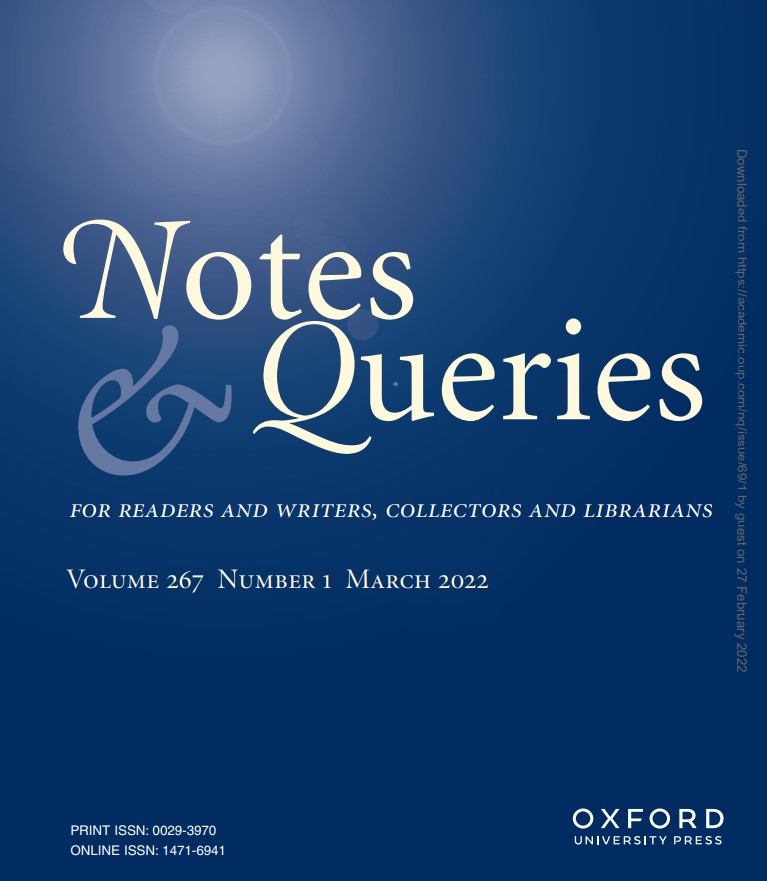
Two Critical Notes on Chinese Elements in Yeats’s Poems by Fu Hao

Recently, Fu Hao, research professor at the Institute of Foreign Literature, Chinese Academy of Social Sciences, published two notes on Chinese elements in Yeats’s poems in Notes and Queries, Volume 69, Issue 1, March 2022 published by Oxford University Press. They are respectively entitled “Who Is the Lord of Chou?” and “Who Is the Queen?” The former points out the errors in the notes and commentaries by Richard J. Finneran, Daniel Albright, A. Norman Jeffares, and others concerning the “Duke of the Chou” mentioned in Yeats’s poem “Vacillation”, and with proper evidence provides the correct answer that the particular Duke of Chou is not the commonly known Duke of Chou, but the senior one, namely, his father King Wen of Chou before he became king. The latter solves the mystery of the identity of the Chinese “queen” mentioned in Yeats’ poem “His Phoenix”, which no one knew before, and concludes from the context that this queen may be probably Wang Qiang (alias Zhaojun), a household name in China.

Links to both articles are listed below:

Who is the Lord of Chou? | Notes and Queries | Oxford Academic (oup.com)

Who is the Queen? | Notes and Queries | Oxford Academic (oup.com)

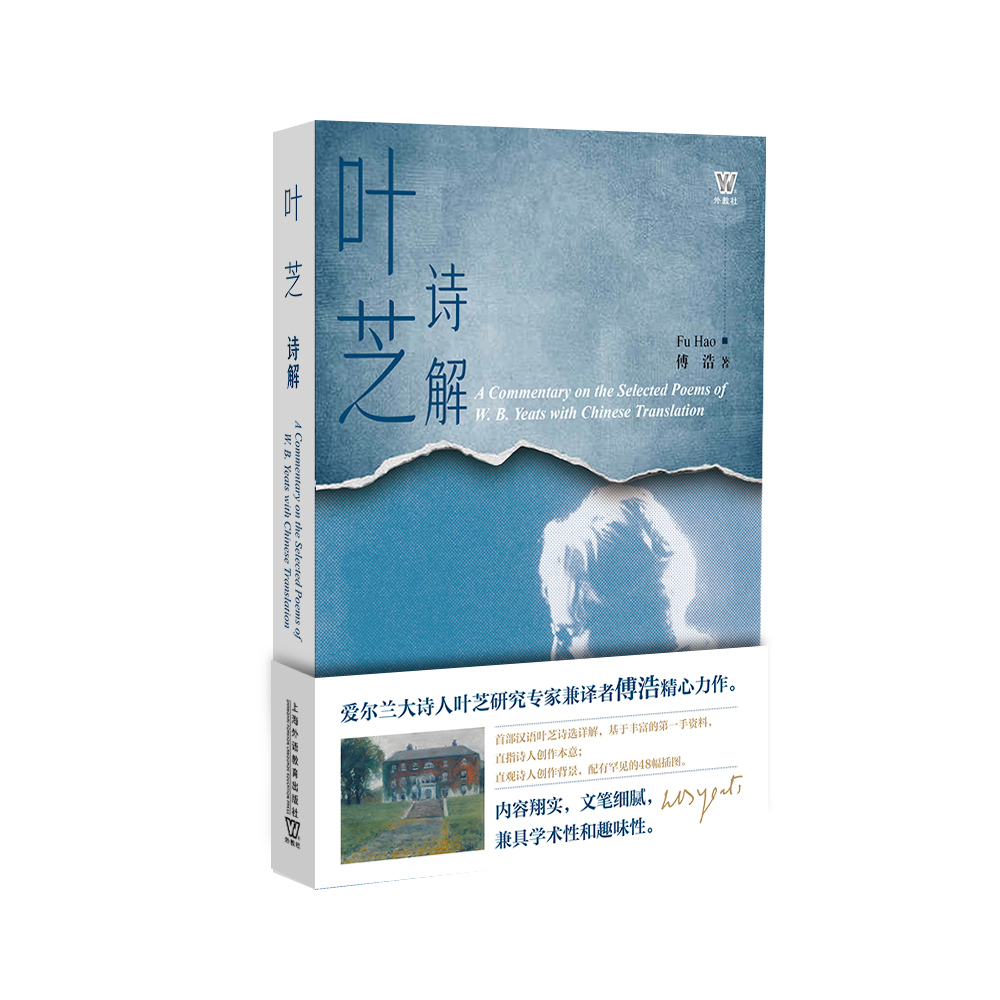
A Commentary on the Selected Poems of W.B. Yeats with Chinese Translation by Fu Hao

Fu Hao’s new book contains a selection of 89 poems by W. B. Yeats in the original, each accompanied by a Chinese version, and a detailed commentary in Chinese, with intention to provide Chinese readers with an understanding of Yeats’s poems and some knowledge of their backgrounds. Adopting the method of textual analysis to read the works closely, striving for every detail, while finding external evidence from secondary information such as biographies of the poet, memories by family and friends, literary traditions, and historical facts, as well as primary sources such as the poets’ autobiographies, memoirs, diaries, letters, essays, novels, plays, and radio broadcast scripts, this book aims at discovering the authorial intention for every poem concerned, and attempting to “read out” its original meaning rather than read in any imposed significance, rejecting the so-called intentional fallacies. Chinese and Western traditions of exposition and commentation are blended in this book to achieve a balanced effect that may be more acceptable to the Chinese audience. The author has made a few unique discoveries, especially about some poems with Chinese elements in them, and when necessary, he has also pointed out some errors made by Yeats scholars at home and abroad.

AUTHOR INFORMATION
Fu Hao is research professor at the Institute of Foreign Literature, Chinese Academy of Social Sciences, China. He has published over 30 books of poetry, essays, literary criticism and translation, including A Critical Biography of W. B. Yeats (in Chinese) and The Complete Lyrical Poems of W. B. Yeats (into Chinese).

Find the link to his new book here!

Rabindranath Tagore and James Henry Cousins: A Conversation in Letters, 1915–1940 Edited by Sirshendu Majumdar

Sirshendu Majumdar’s new book has recently been published by Routledge!

This book presents a set of original letters exchanged between Rabindranath Tagore, the first Asian to win the Nobel Prize for Literature, and the eminent Irish poet and theosophist, James Henry Cousins. Through these letters, the volume explores their shared ideas of culture, art, aesthetics, and education in India; aspects of Irish Orientalism; Irish literary revival; theosophy, eastern knowledge, and spiritualism; cross-cultural dialogue and friendship; Renaissance in India; anti-imperialism; nationalism; internationalism; and cosmopolitanism. The book reveals a hitherto unexplored facet concerning two leading thinkers in the history of ideas in a transnational context.

With its lucid style, extensive annotations and a comprehensive Introduction, this book will be an essential read for scholars and researchers of Indian literature, Bengali literature, comparative literature, South Asian studies, Tagore studies, modern Indian history, philosophy, cultural studies, education, political studies, postcolonial studies, India studies, Irish history, and Irish literature. It will also interest general readers and the Bengali diaspora.

York Conference 2021

Yeats and English

10-12 December 2021

Ye Olde Cheshire Cheese, London

For England may keep faith
For all that is done and said

W.B. Yeats, “Easter, 1916”

I remind myself that … I owe my soul to Shakespeare, to Spenser, and to Blake…and to the English language in which I think, speak and write, that everything I love has come to me through English

W.B. Yeats, “A General Introduction for My Work”

Given all the devolutions of British, Irish and world anglophone literatures, one small question became decentred quite some time ago: what is W.B. Yeats’s place in ‘English’ literature? It is a moot point whether Yeats thought that England would keep faith or whether a history of perfidy would continue. Yet the Englishness of Yeats is clear, and not just his inability to read or write in any other language: Blake, Spenser, Shelley, the poets of the Cheshire Cheese, Bedford Park, Stone Cottage, George Hyde Lees, the Macmillan Company. 

Yeats’s technical facility has secured for his poetry a central place in recent accounts of the persistence of Renaissance and Romantic models in the English-language poetry of the twentieth century. His poetry serves as one template for reading for form by student and poet alike. Yet in certain institutional ways his work has settled into the ‘Irish’ parts of the study and criticism of an international English Literature, from modern undergraduate curricula to major publishing presses. Given their tangential relationship with recent configurations of ‘modernism’ – historical professionalism and an emphasis on cultural specificity – the new conventions of ‘English’ have reconfigured the historicity of literary form, prioritising its many cross-historical and supra-national influences and collaborations. 

If many latter-day modernist studies emphasise an internationalist dimension, then what does their criticism make of Englishness as a regional category? Can we look again at a revised English canon forged by Yeats, along with other non-English London-based writers, like Eliot or Pound? And as English national identity rises again from a seeming dormancy, what has Yeats’s writing about – and participation in – national movements in history have to say to English writers and readers as they face a contemporary version of the ‘rough beast’ of illiberal political change?

Plenary speakers:

Peter McDonald, Christ Church, Oxford

Caoimhe Nic Dháibhéid, University of Sheffield

This symposium will enable participants to address a variety of topics suggested by the conference theme. Themes include:

Yeats and the English poets

Yeats and British regional modernism 

Literary London: Shaw, Wilde, Yeats, Eliot, Pound

The influence of Yeats on modern and contemporary poetry 

The end of Empires

Yeats’s politics and the inflexions of nationalism

Yeats and British policy in Ireland

Contemporary literary theory and the challenge nationalisms

Identity and poetry

Poetry and international theatre: polyglot form, monoglot writing

It is hoped to run this as an in-person event as far as possible. There will be hybrid element to the conference if Covid restrictions continue, with some sessions accessible online. 

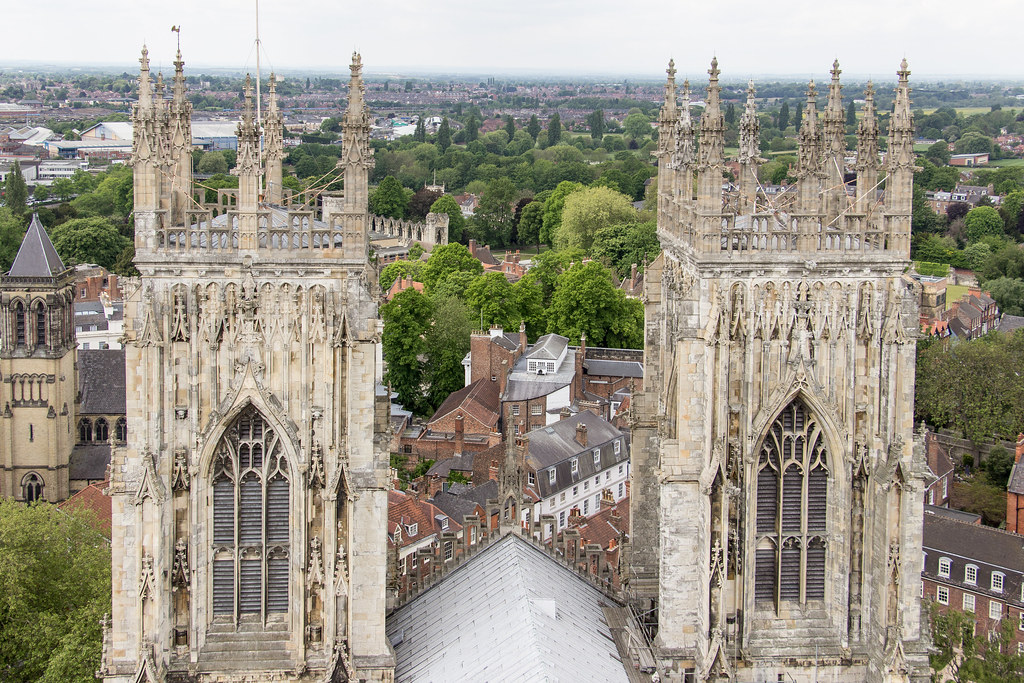
The Conference will take place in a city centre venue, The York Medical Society, Stonegate, York; restrictions permitting, we will also have an event in the University of York’s King’s Manor.

December in York can be busy due to tourism and Christmas shopping, so delegates are encouraged to book well ahead through the usual booking apps or through this website: https://www.visityork.org/ 

There is a small number of bookable rooms available in Franklin House on the University campus on a first come first served basis, about 20 min bus ride, 1.5 ml walk, from the city centre: https://yorkconferences.com/franklin-house/

Please forward paper proposals to the organising cttee via Matthew Campbell by 15 October 2021.

Registration will open September 2021.

Contact Matthew Campbell: matt.campbell@ york.ac.uk

The Sligo Yeats Society Needs Support

Due to the disruption caused by the pandemic, the Sligo Yeats Society is in danger of imminent closure, and this has put the future of the International Yeats Summer School, which the Society supports, in jeopardy. 

For more information, please see this recent article from The Irish Times. For a response from current and past directors of the International Yeats Summer School, please see their letter. People interested in donating should visit the Sligo Yeats Society website.

« Older posts Newer posts »